A core idea in behavioral economics is that customers don’t always behave rationally. From Dan Ariely’s Predictably Irrational onward, we’ve had a language for the ways decisions deviate from purely logical models.
That lens has been useful, but it may also have led us, subtly, in the wrong direction. What if many of the decisions we describe as “irrational” aren’t irrational at all? What if they’re meaningful – but we’re missing the context that makes them make sense?
In my work, I’ve found that what often sits underneath these decisions is tension. Not random inconsistency, but a structured set of competing forces that people are trying to navigate in their lives. Some of those tensions show up again and again:
People want to feel independent, but modern life makes them dependent on systems.
People want to feel disciplined, but their days are chaotic.
People want to express their individuality, but they also want to feel a sense of belonging.
People want to become a better version of themselves, but change is difficult.
When we only look at the customer’s specific decision, it can seem inconsistent or even contradictory. But when we look at the tension the decision is helping resolve, a different kind of logic appears.
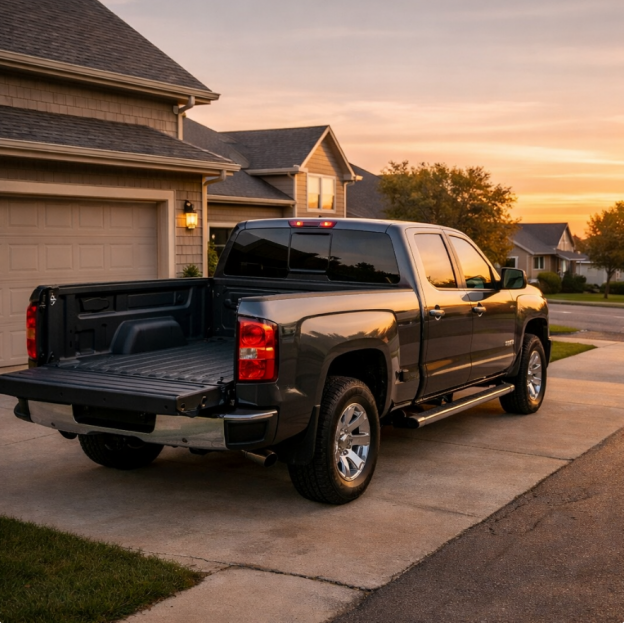
Take a familiar example: the pickup truck. Drive through almost any suburban neighborhood in the U.S., and you’ll see them – large pickup trucks parked in driveways, often spotless, their beds empty. For many of these owners, the truck is rarely used for hauling or towing. Day to day, it’s used for commuting, errands, and school drop-offs. From a purely functional standpoint, it’s more vehicle than most people need. It’s harder to park, more expensive to run, and less efficient than many alternatives.
And yet, it’s a remarkably common choice. If we look at that through a purely logical lens, it’s easy to see the decision as inefficient, or even irrational. But look at it through the lens of tension, and something else comes into view.
(Looks irrational on paper. Makes perfect sense in context.
For many buyers, the pickup truck sits at the intersection of independence and dependence. Even if daily life rarely demands it, the truck carries the possibility of self-sufficiency – the sense that “I could handle it if I needed to.” In a world where so much of life depends on systems, services, and other people, that feeling has real value.
At the same time, the truck often navigates a tension between individuality and belonging. It signals a certain identity – capable, practical, grounded – while also connecting the driver to a broader cultural narrative that feels familiar and shared.
Seen this way, the choice isn’t irrational. It’s helping the customer navigate tensions that aren’t visible if we only focus on features, price, or stated needs.
Once you start looking at customer behavior through this lens, patterns begin to emerge. Decisions that once felt inconsistent start to feel structured. What looked unpredictable starts to feel, in many cases, surprisingly coherent.
I explore this lens more fully in my new book, The American Customer: The Hidden Forces That Shape Choice, which is now officially out. The book looks at how culture and identity shape the way people interpret their choices – and why those choices carry meaning that isn’t always immediately visible. It offers a way to move beyond describing behavior to actually decoding it.
The book is available here.
I’ve also been developing these ideas further in a presentation, Decoding the American Customer, where I explore how to identify these tensions and apply them in practice. If that would be useful for your team or organization, please contact me at jay@bureauwest.com.
Source: “The American Customer: The Hidden Forces That Shape Choice,” Jay Zaltzman, March 23, 2026