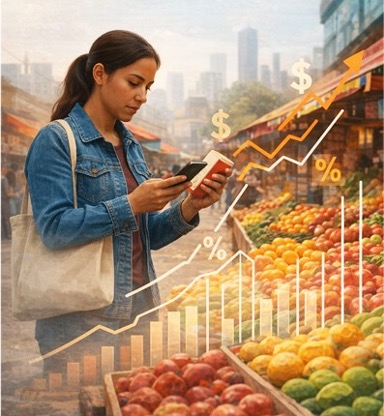
Economic uncertainty has long been part of the Latin American context. Inflation, currency volatility, and political transitions are familiar realities for consumers across the region.
However, uncertainty does not simply reduce consumption. Instead, it transforms how consumers prioritize, evaluate, and experience value.
Across Latin America, households continuously adapt their spending habits in response to changing economic conditions. These adaptations are often subtle but deeply influential in shaping market dynamics.
Consumers Are Becoming Strategic Buyers
Latin American consumers have developed a remarkable capacity to adapt to economic fluctuations. When financial uncertainty increases, consumption rarely stops altogether. Instead, consumers become more strategic in how they allocate their resources.
Price comparison, promotion hunting, and brand switching become more common behaviors.
In Argentina, for example, high inflation has led consumers to monitor prices almost daily. Many households compare prices across supermarkets, neighborhood stores, and online platforms before making routine purchases. Bulk buying and stockpiling of non-perishable goods often occur when consumers anticipate price increases.
In Brazil, discount retail chains and cash-and-carry formats have expanded significantly as consumers look for better value while maintaining product quality.
Similarly, in Mexico, many households actively monitor promotions offered by large supermarket chains as well as local neighborhood stores, choosing where to shop based on weekly discounts.
These behaviors illustrate how consumers do not simply reduce consumption—they optimize it.
Value Is Being Redefined
In uncertain economic environments, consumers rethink what “value” truly means.
Value in Latin America is rarely defined by price alone. Instead, it often reflects a combination of factors such as product durability, brand trust, emotional satisfaction, and family benefit.
In Colombia, for example, many households have shifted toward products that offer longer-lasting value, even if the upfront price is slightly higher. Durable goods and multipurpose household products often become more attractive in times of financial uncertainty.
In Mexico, trusted brands frequently retain consumer loyalty even when lower-cost alternatives are available, particularly in categories such as food, household staples, and personal care.
Meanwhile, in Peru, consumers often prioritize products perceived as contributing to family well-being—such as healthier food options or educational services for children—even during economic pressure.
For brands, this means that value propositions must address both functional and emotional needs.
Smaller Luxuries Are Replacing Large Purchases
One common pattern across many Latin American markets is the postponement of large purchases during uncertain economic periods.
Consumers often delay buying vehicles, electronics, appliances, or home renovations until economic conditions feel more stable.
However, this does not mean consumers abandon discretionary spending altogether.
Instead, many consumers replace large purchases with smaller indulgences that provide emotional satisfaction.
In Brazil, for example, premium chocolate, specialty coffee, and higher-end personal care products have remained resilient in periods of economic volatility.
In Mexico, affordable restaurant meals, street food experiences, and small lifestyle treats often serve as accessible ways for consumers to maintain enjoyment despite financial constraints.
In Chile, consumers have increasingly turned toward smaller experiential purchases—such as dining out or short local trips—instead of more expensive long-term investments.
These small luxuries often play an important psychological role during uncertain times.
Informal Innovation Is Creating New Consumption Models
Latin America’s informal economy has historically functioned as a powerful mechanism for economic adaptation.
When financial pressures increase, consumers frequently develop creative strategies to maintain access to goods and services.
In Mexico, neighborhood stores (tienditas) often offer flexible purchasing arrangements, including informal credit or the ability to buy products in small quantities.
In Argentina, resale platforms and second-hand markets have expanded significantly as consumers seek more affordable alternatives for clothing, electronics, and household items.
In Brazil, social media platforms have enabled a new wave of micro-entrepreneurs who sell food, clothing, cosmetics, or services directly within their communities.
These informal networks are not merely survival strategies—they are dynamic ecosystems that shape how products circulate within local markets.
For companies, understanding these alternative consumption systems can reveal opportunities that traditional retail data often overlooks.
Trust Becomes Even More Important
During times of economic uncertainty, trust becomes a crucial factor in consumer decision-making.
Consumers are more cautious about how they spend their money, which often strengthens their reliance on brands they perceive as reliable.
In Chile, where public debates around corporate responsibility have intensified in recent years, consumers increasingly expect transparency and fairness from companies.
In Mexico, brands that demonstrate consistency in product quality and pricing often maintain stronger consumer loyalty even during economic downturns.
In Brazil, companies that communicate empathy and understanding toward consumers’ financial realities—through promotions, accessible product formats, or responsible messaging—tend to strengthen long-term relationships.
Trust becomes not only a marketing asset but also a strategic advantage during uncertain times.
Understanding Consumer Adaptation
Economic uncertainty is often interpreted primarily as a constraint on consumption.
In reality, across Latin America it often functions as a catalyst for behavioral adaptation and innovation.
Consumers become more strategic, redefine value, seek affordable sources of enjoyment, and develop new ways to access goods and services.
Many of these behavioral changes are subtle and cannot be fully captured through traditional quantitative data alone.
Understanding how consumers navigate these challenges often requires deeper qualitative insight into the motivations, trade-offs, and cultural meanings behind their decisions.
At Fieldable Research, qualitative and ethnographic research across Latin America frequently reveals these everyday adaptations—helping companies identify emerging consumption patterns and anticipate shifts in consumer priorities.
In a region where economic conditions can change quickly, understanding how consumers adapt is often the key to understanding the future of the market.