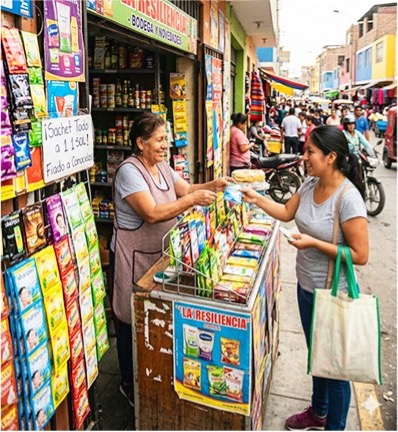
In Latin America, the informal economy is not a marginal phenomenon – it is a defining feature of daily life. Across the region, a significant portion of economic activity occurs outside formal regulatory frameworks, influencing how consumers earn, spend, and innovate. For market research buyers, understanding this dynamic is essential: informal economies are not just constraints – they are powerful engines of consumer-driven innovation.
The Scale and Nature of Informality
In countries such as Mexico, Brazil, and Peru, informal employment can account for 40–70% of the workforce. This includes street vendors, independent service providers, micro-entrepreneurs, and gig workers operating without formal contracts or protections.
But informality is not simply about lack of regulation – it is about adaptability. Consumers in these environments develop highly resourceful behaviors to navigate income volatility, limited access to credit, and inconsistent infrastructure. These behaviors often translate into innovative consumption patterns that differ significantly from those in more formalized economies.
Innovation Born from Constraint
One of the most important insights for researchers is that constraint fuels creativity. When traditional systems fail to meet consumer needs, people create alternatives.
- Micro-packaging and fractional consumption
Consumers with irregular income streams often prefer to buy in small quantities, even at a higher unit price. This has driven the success of single-use sachets for products like shampoo, detergent, and even cooking oil. What began as an adaptation to affordability constraints has become a mainstream packaging strategy across emerging markets. - Alternative financial ecosystems
Limited access to formal banking has led to widespread adoption of informal credit systems, rotating savings groups (tandas), and cash-based installment purchasing. More recently, fintech companies have begun to learn from these behaviors, designing digital solutions that mimic informal trust networks. - Hybrid retail models
In many urban and peri-urban areas, the line between retailer and consumer is blurred. Small neighborhood stores (“tienditas”) double as credit providers, community hubs, and distribution points. Informal vendors also act as last-mile delivery networks, often outperforming formal logistics systems in reach and flexibility.
Case Examples
Mexico: The resilience of tienditas
Despite the expansion of modern retail chains, traditional corner stores remain dominant in many regions. Their competitive advantage lies in personalized service, informal credit, and hyper-local knowledge. Some brands have successfully partnered with these stores, creating tailored distribution and promotional strategies that leverage trust and frequency of interaction.
Brazil: Beauty entrepreneurship in favelas
In low-income communities, informal beauty salons and independent stylists have become influential nodes of product discovery and brand advocacy. These entrepreneurs often experiment with product combinations and techniques, effectively co-creating trends with their clients. For beauty brands, they represent both a distribution channel and a source of grassroots innovation.
Peru: Informal transport and mobility solutions
Before the rise of app-based mobility platforms, informal transport networks filled critical gaps in urban mobility. Even today, many consumers rely on a mix of formal and informal options, cost optimization, speed, and convenience. Mobility startups entering these markets have had to adapt to these hybrid behaviors rather than replace them.
Implications for Market Research Buyers
Understanding informal economies requires a shift in research approach. Traditional frameworks – focused on formal employment, stable income, and predictable consumption – often miss critical insights.
- Rethink segmentation
Income-based segmentation may be insufficient. Researchers should consider liquidity patterns, income volatility, and access to informal networks as key variables. - Capture real behavior, not stated behavior
In informal contexts, there can be a gap between what consumers report and what they actually do. Ethnographic methods, in-context observation, and mobile diaries can reveal hidden practices that surveys might miss. - Engage non-traditional influencers
Informal entrepreneurs – shop owners, stylists, delivery workers – often play a central role in shaping consumer decisions. Including them in research design can unlock deeper insights. - Design for flexibility
Products and services that succeed in these markets are often modular, adaptable, and resilient to disruption. Research should explore not just product fit, but usage flexibility under different constraints.
From Informality to Opportunity
For too long, informality has been framed as a barrier to growth. In reality, it is a dynamic system that fosters ingenuity, resilience, and localized innovation.
For market research buyers, the opportunity lies in decoding these behaviors—not to “formalize” them, but to learn from them. The most successful brands in Latin America are those that embrace the logic of informal economies, designing solutions that align with how people actually live, work, and consume.
In this context, informal economies are not just shaping consumer behavior—they are actively redefining the future of innovation.