Archives

Research Blind Spots: Understanding the Impact of Culture and Literacy Levels

Towards the end of 2015, two of my QRCA colleagues—Susan Abbott from Canada and Ilka Kuhagen from Germany—presented a creativity workshop to qualitative researchers in South Africa. At the Johannesburg session, one of the attendees mentioned that some of the techniques covered may not work well among lower economic segments of our population due to limited literacy. His comment intrigued my two colleagues, both from developed countries. This incident made me think more consciously about the need to adapt the way we conduct grass-roots research in my country and how this may be similar or different in other emerging countries.

Accordingly, I conferred with 21 fellow qualitative research consultants in 12 different countries. I focused on emerging economies, the BRICS siblings (Brazil, Russia, India, China and South Africa) but also included colleagues who specialize in multi-cultural research in the U.S. and Australia.

I was surprised to hear from colleagues in non-African countries, including those who attended my session about this topic at the 2017 QRCA Annual Conference, that they are seldom asked to research the lower end of their market. It is well documented that middle-class growth is exploding in emerging economies. This growth is likely to come from advancements up the consumer ladder. Is it wise to focus research on those who are already established middle class while neglecting the feeder market, the future middle class?

Lower-income segments can offer new growth opportunities for marketers only if they bother to understand these potential customers’ unmet needs. This is a win-win for marketers and the public, as better access to products and services uplifts these consumers and enables their advancement to middle class. But, we cannot assume that their needs and priorities are necessarily the same as the established middle class that forms the focus of most commissioned research. In some markets, there may be a huge HDTV dominating a home that may not have a refrigerator, a bathroom or even running water. In South Africa, we are used to the sight of satellite TV dishes on the rooftops in informal settlements. The cost of consumption is higher for these targets—they have fewer resources and less disposable income and must use these smartly. Every market is unique; there are great differences in the way consumers cook or do laundry across South America, Africa, Eastern Europe and Asia.

If we agree that it is important to understand the needs of lower income segments on their journey towards becoming emerging middle class, there are factors to consider to ensure that we truly hear and understand them. These include the impact of literacy levels and culture.

In some markets, literacy is a problem among the lower socio-economic groups due to attenuated or poor education. Their limited abstract conceptual skills impact the way moderators can engage with them, so complex stimuli don’t work. Their limited verbal skills and shortcomings in expressing their thoughts and feelings make written formats unusable.

In other markets, such as Russia and China, the regimes placed greater emphasis on education, so low literacy is not a factor. Russia has a literacy rate of 99.7{a75d112c1ea8efd8d548fa031ca8ffd35154d8dad1867f6f7c53f2160deae159}, while in China the literacy rate is 96{a75d112c1ea8efd8d548fa031ca8ffd35154d8dad1867f6f7c53f2160deae159}.

Language is crucial and has implications with regard to both culture and literacy. The level of English used in communication (such as discussion guides, concepts and test materials) needs to be simplified in many local languages. The vocabulary of many languages is not as granular as English. African vernacular languages, for example, don’t have separate words for love and like. Another example was provided by Pia Mollback-Verbic. In communication testing in India for a deodorant brand, the word “cleavage” was used. Pia said, “The Hindi translation is ‘a valley between two mountains.’ The moderator didn’t know how to correct the language into something more ‘culturally appropriate,’ and the poor consumers were mighty perplexed about the entire thing.”

One of the “cardinal sins” of global research is clients insisting that respondents be recruited who are fluent in English in non-English or multi-lingual countries. It is not realistic to ask for English-fluent consumers except in the highest socio-economic classes (including business-to-business) and depends on the target market and type of study. My South African colleague, Lesley Croskery, presented the findings of her research about this topic at the 2016 QRCA Worldwide Conference, which vividly illustrated the different quality of feedback, described by participants as “the inner me” versus “the deeper me” elicited when one frees a person to express themselves in their first language rather than insisting that they speak English. In the words of the late statesman Nelson Mandela, “If you talk to a man in a language he understands, that goes to his head. If you talk to him in his language, that goes to his heart.”

Dress is another important consideration for visiting research teams when they conduct research in certain markets. It is important to blend in with the target group you are researching by dressing modestly. Listen to your local partners if they suggest that you remove your jewelry or tone down your outfit. It is also necessary to respect the cultural norms of a society. Examples of this include cultures where women wearing trousers is frowned upon or where women are expected to cover their heads. If you don’t respect these norms you run the risk of offending your participants or being dismissed by a tribal leader, both of which will endanger the quality of engagement with your participants.

Comments from colleagues I interviewed reiterated insights from the presentation “Water Wows” by Piyul Mukherjee and Pia Mollback-Verbic. It illustrated why multi-country research design cannot be “one size fits all.” Although Piyul and Pia’s paper referred to Western versus Eastern culture, the principles they highlighted apply to other emerging markets as well. Differences between the individualistic society of the West vs. the collectivist society of most emerging markets must be understood and respected. People in the Third World are more gregarious and used to solving problems within the community rather than individually. The way people share their opinions differs. In Western culture, direct questions will elicit direct answers. Criticism and scepticism are more easily expressed without holding back. In Eastern cultures and other emerging markets, questions are answered in an indirect, organic, roundabout way. People are inherently polite and, per their cultural norms, will not be critical to your face.

What are the practical implications of these literacy and culture factors when we conduct global research with lower income groups? What impact does literacy and culture have on the way we word and structure the discussion guide, the methodology we choose and the projective techniques we use?

Time management is very important, and it is wise to build in extra time. Allow more time for introductions and ice-breakers for respondents to feel comfortable and to build trust. Allow more time for each field event, as it simply takes longer to recruit than in Western cultures. In a group discussion, everyone wants to be heard, and the language may be more verbose so that it takes longer to express thoughts and feelings.

Simplify the discussion guide to its essentials, and make it clear what the “must have” information is. Simplify language by using words that are relevant and understandable to the culture. Modify exercises to something participants can relate to as relevant to their culture and traditions.

Avoid or take care with written tasks such as bubble drawings, sentence completion and letters. Scales and ratings are also tricky and easily misunderstood.

Limit the number of concepts being tested — too many can confuse consumers, especially if the differences between concepts are too subtle or too abstract. Raji Bonala recommended reducing the number of concepts tested per session, eliminating ones clearly not working, or rewriting language to be more meaningful to the culture.

Which methods work best for these targets? Many of the colleagues I interviewed in different parts of the world mentioned ethnography first when I asked this question. Ethnographic methods bring us closer to reality to observe actual behavior rather than relying on verbalization of reported behavior. Participants are more at ease in their own home with familiar objects and can express themselves better when they can “show and tell.” Ethnography is also ideal for clients to get firsthand exposure to the lifestyle and consumer behavior of target segments. Client teams should be kept as small as possible because a large entourage can be intimidating and impractical in small homes. Nandi Mswane believes it feels more natural and less threatening to participants in South Africa when client observers also take part in the conversation, rather than acting like a silent jury.

When the cultures are more collectivistic and community oriented, friendship groups and paired interviews work very well. Respondents feel more comfortable in the presence of a friend, colleague or family member. The informal, relaxed chatting between them yields rich language and reveals true feelings and actions.

Cultural norms need to be considered when planning group discussions. In some cultures, it is unacceptable for younger people to speak before older people, so it is better to recruit a homogenous age range in the same group. Groups in people’s own environment (e.g., township) may work better than in an upmarket facility. Ideal group size can differ from culture to culture. In India, smaller groups of six are ideal because participants tolerate multiple people talking at the same time.

What about digital methods? Do they work? This depends on consumers’ access to mobile devices versus computers, Internet penetration and data costs. For example, most digital platforms work well with China’s tech savvy participants.

Mobile works well in South America, Africa and India. Most people there have mobile phones, and smart phone ownership is rising rapidly with Android devices still more common than Apple iPhones. Often participants in South Africa and India already have WhatsApp on their phones. Their familiarity with WhatsApp can make it a better choice than traditional market research platforms and apps.

Many colleagues invite participants to reply by video rather than text. Some cultures (such as Brazil) like selfie videos. In India it may be more comfortable if someone, perhaps a family member, asks questions to the participant. Showing something by sharing a picture or video clip minimizes the need for too much text typing.

Which projective techniques work well to reveal richer insights for these lower socio-economic groups? Personification emerged as a favourite tool, but it is necessary to adapt the metaphor to be relevant to the specific culture. Brand party can work but needs to be adapted to social occasions relevant to the culture. In collectivistic societies, relationships are important and can offer rich metaphors: which of the brands in a category is the grandfather, the mother, the wealthy uncle, the naïve child? With projective techniques, it is important to simplify the technique and adapt it to a situation that participants can relate to.

When using projective techniques, add visual stimuli like pictures, photos, mood boards or physical objects that help respondents express themselves and compensate for limited verbal skills. Desleigh Dunnett shared a wonderful example with me of tactile ranking used in the Northern Territory of Australia (see Figure 1). Community members discuss social problems in their community and sort nuts into different sized heaps to indicate the prevalence and impact of different social problems in their community. This physical ranking activity goes hand-in-hand with much debate of which problems are greater than others and why, an enabling technique in the true sense of the word.

TIPS

Limited literacy or cultural factors can make it difficult to keep engagement high and get quality insights. Here are a few tips from the field:

  1.   Involve a local researcher/moderator to help you to close or minimize the cultural gap.
  2.   Avoid complexity and simplify anything with the potential to cause confusion.
  3.   Avoid writing exercises. Instead use visual stimuli to encourage verbalization.
  4.   Make questions, exercises and metaphors relevant and familiar to their culture.
  5.   Create a situation and environment so participants feel comfortable and relaxed enough to reveal their “deeper me.”
  6.   Treat participants with dignity by respecting their cultural norms and personal environment.

Research Blind Spots: Understanding the Impact of Culture and Literacy Levels originally was published in the Summer 2017 edition of QRCA Views. PDF here.

Acknowledgements

I would like to acknowledge and thank the following colleagues who generously shared their experience and wisdom with me:
Brazil: Daniela Sene Grandi, Mauricio Prado, Sofia Costa Alves
Mexico: Astrid Velásquez Potenes
USA: Isabel Aneyba
China: David Ying Hon Ho, Jinghuan Liu Tervalon
India: Pia Mollback-Verbic, Raji Bonala
Indonesia: Farah Putri
Russia: Marina Ponedelkova
Australia: Desleigh Dunnett
Romania: Oana Rengle
Turkey: Serra Bozkurt
Kenya: Mokeira Masita-Mwangi
South Africa: Iske van den Berg, Jack Hlongwane, Lesley Croskery, Manoko Jegede, Marna Kirchner, Nandi Mswane



Political Communication In The Age of Broken Expectations

MEXICO – Communicating a message to a person or a society that is optimistic, hopeful and growing, requires a different process than addressing someone who is stressed, insecure, unsure of their future society, or is continuously subjected to bad news or personal or social failures that demoralize them.

Political communication – to be called such – must consider, above anything else, the state of mind that hears the message, what is going on in the consumers’ brain and – as such – the inner murmurs of the society’s spirit.

Without this type of communication – without this method – messages and characters fail, falling into oblivion, being ignored or rejected offhand. We could call it ‘communication without a subject,’ a blind message that lacks the precise aim supplied by the knowledge of a unique and forever changing society.

In Mexico (and many parts of the world) political communication is designed vertically, coming only from a war room, or think tank, and staking it all on the genius (either real or perceived) of a political operator and his/her team.

A message is imagined, an information capsule is modeled, a slogan is written and off to the public arena we go …. This is usually a very unfortunate course of action.

We believe we must work exactly backwards. We must first study the subjects the communication is directed to, their personal circumstance and their social mood, and through that dynamic and analysis we build our messages.

It is about erecting two simultaneous columns:

  1. Knowing the real sensibility of society at a point in time (a valuable sociological asset for almost any decision-making process)
  2. To make a comprehensible discourse, better in tune to the mood of that society we are addressing

In this type of political communication, we need to comply with the recommendation of the philosopher Heinz von Foerster: “To communicate is to establish a dialogue, that is to say, see yourself in the eyes of your counterpart.”

That is the starting point of this article.

Political communication

A few years ago, political campaigns in Mexico were common place: repetitive, boring, with a vague remembrance of a relevant message and far from getting people riled, they mostly generated rejection and upset.

Diagnostics are varied and some are very interesting. We could blame the traditional ‘political communication model’ with its 92 daily spots per station that go on for many weeks. And there is some truth in this, but …

… we believe that there is divorce between the elite, especially the ‘political class’ and the population.

This is becoming an ever-growing abyss that is unassailable: nothing the ‘politicians’ say is credible or deserving of attention and reflection. Our democracy and elections are mediated by a big wall located between parties and candidates, citizens and voters.

We insist: there is a bit (or a lot) of truth in all of this. But both explanations (and others) omit a crucial question: What is happening in that society towards who those political messages are directed? How has the ‘spirit of the times’ (or now, the so-called ‘trending topic’) evolved over the last years? In short: isn’t it clear that all communication must know the social mood before making any decision, any phrase, production or message? Evidently, this diagnostic and type of communication work is very complex and requires a power of exploration and research of the social mood that is very rigorous and representative. (1)

We believe that very few have taken this leap on the concept of political communication, which mostly explains the failed and broken campaigns; the divorce between political communication and impacting or reaching voters.

The issue is that simple marketing that offers manufactured data and messages is the still dominant process followed by political communicators; and this has the defect of not considering either the social mood, the history or context, or the type of society it represents.

Today’s Mexican society is not the same as in 2000 or 2010, much less than of the 1990s of last century. A series of processes, happenings, perceptions, and especially broken expectations, have molded a spirit loaded with worries and despair.

Of course, the whole country has not evolved in the same fashion, or the same scale, nor at the same speed. However, the general tendency over the last two decades shows that Mexican society is one that is tired of failing and hearing empty promises, with few opportunities for growth and building a better future, where the doors close, without an exit in sight.

This fact is not exclusive to Mexico, of course – much less after the great crisis that convulsed the world’s economy – but Mexico’s social mood had a deeply seated pessimism since the mid-90s and the so called ‘Tequila Effect’ crisis.

Our social mood research starts there: when we realize that something is failing in the many communication attempts, both in commerce and politics. A wall was being erected around Mexican consumers, and the messages transmitted by corporations or governments and not impacting people’s minds, or are rejected, or perceived as not trustworthy, or even annoying.

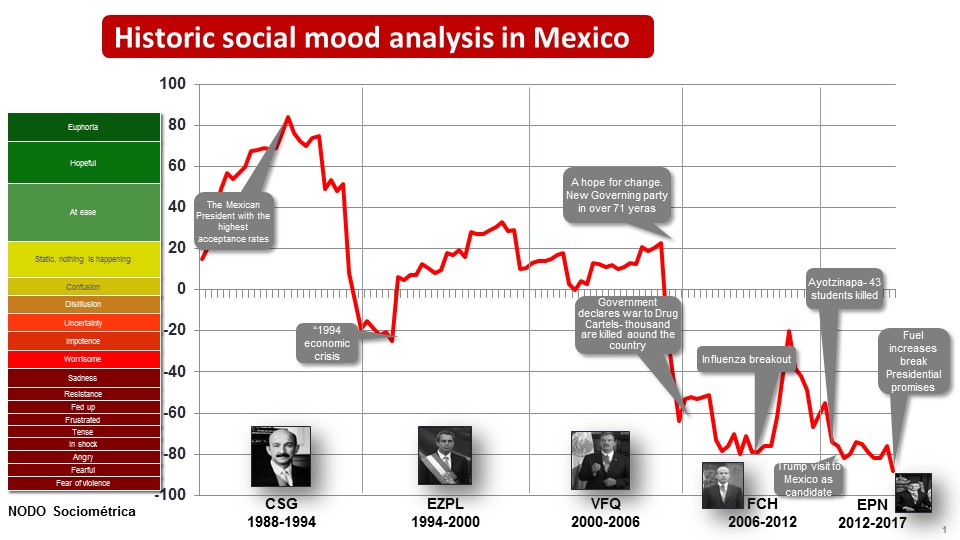
This table shows how the social mood has suffered dramatic changes that go from euphoria to being angry and even feeling fearful. (Click the table to expand it.)

The first column shows a social mood ‘thermometer. The bottom shows the six-year-long presidencies since 1988.

The table shows dramatic changes going from Euphoria to Disillusion in only three years. It is like a roller coaster for the mood in Mexican consumers.

graphic showing analysis of historic social mood in mexicoSpokespeople, institutions, brands, media, political candidates and a long list of political parties made immense efforts – sometimes heroic ones – to reach out to consumers, but they were all insensitive and out of phase with the public. You can see the worrisome history of this phenomenon in the graph.

The simple data battery of empiric correlations show that the two preceding decades are not a stage of stability, but rather contingent oscillations of suspended activity: jobs, productions and income. In these fluctuations, society has become more unequal.

Episodes in Mexico’s recent economic history can be appreciated in the graph: the fall of our external accounts and banking system in 1994-95; the longest recession in modern history (38 months) between August 2000 and September 2003; the effects of the financial crisis in 2009; a continuous deceleration of the economy during the second semester of 2012 with a virtual recession in 2013 and a downside expectation for 2016 and 2017….

That’s it for economics, but there is also a role to be played in events and how they affect social mood: the expectations generated during the regime of President Carlos Salinas; the arrival of the democracy and the triumph of Vicente Fox; the post-electoral crisis in 2006; the everyday news of violence and killings in the country; the capture and jailing of Elba Ester Gordillo, the tragedy of Ayotzinapa and the 43 disappeared students; the escape of El Chapo and many other news events and circumstances play a role as relevant as the economics.

These feelings have been typed through a carefully designed system that has allowed us through the last few decades to map out the growth, diminishing or resurgence of patterns of behavior among Mexicans.

Different rationalities and sensibilities are mapped out by segment. For example, the optimist (ever in decline), negative, evasive, and the aggressor – citizens whose frustration makes them prone to violence and intolerance.

Our methods have been applied to other countries also facing processes of degradation in perception, emotions and vision by their citizens.

But the Mexican case is unique, because it has been at the bottom of the international scale for decades. A piece of data: Mexican women are the most stressed out in the world, after women in India ….

To summarize: Our society has changed massively in the last 20 years, but not in a positive way.

People who fail, who permanently live on the stress limit, fearing their environment, without security for the future, and who do not have a minimal assurance of survival tend to compare themselves to their neighbors, making a corrosive atmosphere “leading to anomia, lack of respect to the rules of living together, and violence….”(2)

All these factors determine conducts and moods, and therefore, a type of sensibility that evermore admits less and less the traditional messages and characters of the governing people.

Therefore, political communication (democratic, I’d say) has become so hard, so unempathetic. It needs to be updated quickly. This is perhaps the most difficult time of communication, because consumers/voters have accumulated a lot of broken expectations.


(1) Before continuing on the central subject, allow me to clear up that ‘Social Mood’ has its roots in  the works of celebrated philosopher Gilles Lipovetsky (The age of emptiness and the Empire of the Ephemeral). However, the concept was extremely useful for the work of moderators and the social analysis of the data, in such a way that NODO patented a novel methodology, making it a trademark under the same name Social Mood (Humor SocialR by its name in Spanish) exported to the US, Chile and Colombia among other countries.

(2) Benjamin Friedman: The Moral Consequences of Economic Growth, Vintage Books, NY, 2005, P 15.

The Walk for Respect for Mexico: Analysis of Conversations in Digital Media

On Feb. 11, 2017 a Citizen March for Respect of Mexico was held in 19 cities across Mexico, and supported by more than 77 civil organizations, educational institutions and business associations.

The aim of the march was to express the rejection of the immigration policies of U.S. President Donald Trump.

Astrid Velasquez and her team studied the social media discourse about this event from Feb. 6 to 13. The analysis drew on a sample of 50,000 mentions, of which 40,000 originated in Mexico. Twitter was the dominant social media used to create awareness about the movement, while local news provided follow-up coverage of the event.

One thing was agreed: there is widespread dissatisfaction with the way in which the Government of Mexico is reacting to the decisions of the current U.S. administration. While there was widespread acknowledgement of the difficulty of changing the situation, there was also a strong desire to protect the dignity of the country.

With respect to the march itself, fewer than 10 per cent of social comments showed enthusiastic support for the march. The majority sentiment about the march was negative, driven by suspicions that the event was created and used by specific politicians for their own political purposes.

The social media analysis provided a rapid and effective way to understand this phenomenon apart from the media reporting on the topic.

To read the full report, download the PDF, The Walk for Respect for Mexico: Analysis of Conversations in Digital Media

8 Key Takeaways from the 2017 Women’s March

The Women’s March of Jan. 21, 2017 was among the largest demonstrations of peaceful protest that has ever occurred, with as many as 5 million participants.

The march captured the imaginations of people in 80 countries.

Images of the march dominated the news cycle and social media.

The Women’s March Conversation: A Global Flash Study

Relaxing on a few days’ vacation after a conference, a few of us were talking about the women’s march.

We wanted to know what impact the march had on the individuals who participated, or were simply interested observers.

Why not launch a flash study to learn more? So we did.

Using a simple, powerful online qualitative platform, and the power of social media, we invited people (men and women) to share their thoughts and feelings about the women’s march.

Participants from 11 countries helped us complete the study within days.

Download the PDF, The Women’s March Conversation Report, to read how we did the study, and our more detailed findings.

Study authors: Susan Abbott, Rebecca Bryant, Ilka Kuhagen, Janina Weigl, with input from ThinkGlobalQualitative associates worldwide.

8 Key Takeaways

Takeaway #1: The march inspired pride, for marchers, and non-marching supporters

Takeaway #2: The message of the march is loosely defined, but centres on human rights

Takeaway #3: People are skeptical about the direct impact of the march on political leaders

Takeaway #4: The march helped those who felt isolated in their views, and provided a source of optimism about the future

Takeaway #5: Some feel the march was a misplaced effort, launched by women who should be happy with their situation

Takeaway #6: For some, the march already has acted as a catalyst for further action

Takeaway #7: The march highlighted the many divisions that exist, among women, and among progressives

Takeaway #8: The march showed what is possible, and may be a foundation for further action

Customer Experience: Mapping the Customer Journey

laptop computer photoForming a deep understanding of the end-to-end customer experience is a powerful tool for developing a stronger competitive position. We live in an experience economy. Competitive advantage is difficult to come by. The low-hanging-fruit of innovation has been exploited already.

Journey Mapping can help you dive deep and find new territory for innovation.

Journey Mapping will put your team in the experience, giving them empathy for the customer, and compelling reasons to mobilize change.

Defining the scope

Our experience with Journey Mapping strongly supports defining the scope of a journey in customer terms, not company terms. The start of the journey begins before the customer touches your web site, your product, your staff or your stores. Extending our enquiry to the natural milestones customers experience often uncovers new territory for innovation, either before or after the traditional boundaries of the experience.

Customer journey studies are well served by hybrid research methods. We can bring in insights from many sources, including a Knowledge Harvest of previous research and public data. Employee Insights can help guide the development of the project, and also enlighten about internal processes and policies that impact the customer experience. Subject Matter Experts that are external to the company can often bring a different perspective as well. We can look at Competitive Intelligence Shops, Social Media Mining, and other tools to fill in specific parts of the picture.

Deep Discovery at the core

Regardless of the other tools selected, individual Deep Discovery Interviews are at the core of Journey Mapping. We want a one-on-one interaction with the customer for a couple of hours on the topic, so we can deeply probe into their experience.

High-definition video is an important part of the record keeping. As we work through these interviews, we will start to develop a rough journey map and test our ideas with customers. By the time fieldwork is done, we will know what the key Moments of Truth are.

Creating the Journey Map

Condensing dozens of ethnographic interviews into a one or two-page Journey Map is a major challenge of analysis. The map is the core deliverable of the project, but we provide full analysis of each Moment of Truth.

Journey Maps will show the stages of the journey in customer terms. At each stage, you will see what customers are doing, what they are thinking, how they are feeling, and what the overall experience is. Pain points and frustrations will be identified.

At this phase of analysis, we also assemble themed Video Vignettes from the many hours of video. For each Moment of Truth, we let the customers tell the story. This is a huge job for the research team, but crucial for your project. Only a few people will experience the customer interactions first hand, but everyone on the team can gain empathy from the video.

We can also work with you to facilitate working sessions to map out a Future Journey, identify and prioritize opportunities. Or our consultants can create an Ideal Journey, and the internal team can refine it.

The Web-Report and Archive

We offer clients a secure, web-based reporting format for multi-media projects. It’s a single archive that contains all project elements, including documents, graphics, and videos. Everyone from executives to the design team can dive a little or a lot into the detailed insights using the web report.Once you have a multi-media report, you will wonder how you ever lived with PowerPoint alone.

We’ll host the site for you during the project, and you can move it to your own internal servers on completion, where it will keep the insights alive.

Want more information? Please contact info@thinkglobalqualitative.com or info@abbottresearch.com or info@ikmarketing.de for more information about the projects or the methodologies discussed, or to arrange for a presentation.

How to Read the Minds of Competitors: Ethical War Games!

illustration for ethical war games articleWhen you launch in the marketplace, how will your competitors react? A facilitated war game is a way to (ethically) get inside the minds of your competitors and determine their most likely actions. It will energize your middle managers, it will improve your launch strategy, and you can do it in a one-day session with some advance planning.

Why we need to think like our competitors

We tend to assume steady-state markets when we plan. We assume that our new initiative will change our results, but we do not think much about competitor reactions. But markets are never still, they are constantly changing. If we make a big splash, there will be ripple effects.

The purpose of war games is to understand a third party. What is the competitor most likely to do based on their history, character, past behaviours, resources and goals? Having now analyzed the most likely move of the competitors, how might we change our own plans?

Who plays war games?

War games can be played with teams representing multiple competitors, or regulators or other stakeholders in the market. Each team is comprised of members of your own staff. The only external participants you would include would be trusted professionals such as agency representatives.

You will need three to eight people for each team. One team represents the Home team, plus each key competitor needs a team. You will want to include people who have been involved with the product under consideration, but also seek out independent and creative thinkers.

Each team gets a briefing kit

We make up a briefing kit for each team that has two components. It has the key facts and data about the industry, that may include tracking study or share information, key findings from consumer research, as well as an industry overview. Each team also receives key information about the competitor they are representing in the game – their history, culture, beliefs, philosophy, stated goals, and recent performance. The kits will be used to help the competitor teams get into character on the day of the games.

Flow of a war games event

We start the day with a short presentation from the launch team, who presents the launch strategy. Then the facilitators present a set of analytical frameworks that will be used by each team, and show them how to conduct their analysis.

Teams are sent to breakout rooms, where they work through the analysis framework. We also give them some help to start thinking the way the competitor thinks. When they come back, they will present answers to the key questions we have given them.

Each competitor team will present the results of their analysis and tell us how the competitor is most likely to respond to our launch. The Home team will also present, but their task is a little different: Their job is to find all the blind spots in the presented launch plan.

The rest of the day is spent developing a stronger launch plan based on the learning from the first sessions. Each team will present a revised plan to the group, and the other teams can challenge it. The strongest options are identified in discussion, and the game is then complete.

What comes out of a war games session?

Team members will have a lot of fun as they do the hard thinking that forms the essence of these games. A fresh perspective will be brought to bear on the launch strategy (or other challenge.) The revised plans will be more realistic and stress-tested without having to wait for the market response. More innovative thinking will come out of the discussions, as well as greater consensus around key themes and priorities for the launch.

After the games, people will continue to use the new ideas gained from the day. The launch team will take the output of the games back, and determine what ideas they will use. It’s fast, fun and an effective use of the team’s time.

Want more information? Please contact info@thinkglobalqualitative.com or info@ikmarketing.de or info@abbottresearch.com for more information about the projects or the methodologies discussed, or to arrange for a presentation.

Spice Up Your Insights: Hybrid Methodology Adds Flavour

hybrid methodology illustrationJust as seasonings enhance the flavours of food, hybrid research designs can enhance the value and richness of insights. Hybrid research approaches also build validation of the insights, and reduce the risk of not hearing the consumer correctly. There are as many ways of building a hybrid design as there are ways of seasoning food! This article will help you navigate past the buzzwords, and see how to spice up your insights.

Definition of hybrid methodology

Hybrid methodology is also known as Bricolage, Triangulation or Mixed Methodology. All of these names refer to the combining or mixing of more than one methodology, approach or conceptual model, to investigate a particular problem or issue from different relevant angles or points of view. Mixing qualitative and quantitative is a common hybrid approach. For us as qualitative specialists, hybrid refers to bringing together a mix of different qualitative methodologies involving individual or group interaction as well as in-person or digital methodologies. Hybrid qualitative can also bring together different target markets, stakeholders, or even expert opinion in our project design.

The use of different methodologies and involving different target segments and stakeholders, results in verification and comparison of the results from the different components of the research. The research team can use this rich data to produce a more detailed and comprehensive understanding of the research challenge.

The value of hybrid design: get closer to reality

The main advantage of hybrid research design is that it yields richer data and enables the research team to layer their experience and enhance their understanding. This produces better insights and more in-depth learning for the research and client team.

The multi-disciplinary approach also helps the team get as close as possible to reality. The mixing of methods relies not only on reported behaviour and recall of actions and decisions, but also endeavors to get closer to observing actual behaviour and evidence of attitudes.

We find that the versatility of the approach is more interesting and fun for participants leading to higher levels of engagement and involvement.

Hybrid methodology allows the voice of the consumer to be heard.

Hybrid methodology confirms the value of the Gestalt theory that the end result is more than the sum of the individual parts as it offers insight into the holistic ‘bigger picture.’

Examples of hybrid projects

The associates of Think Global Qualitative believe in the value of hybrid design and many of our most impactful and innovative projects have used this approach. Some examples of projects that we have been involved in either as a global network or individual consultants, have included:

  • A global study with dog owners in Canada, Czech Republic, France, Germany, India, Mexico, South Africa, UK, and USA which utilized a combination of digital methodologies including individual smartphone diaries to immerse into the lives of dogs and their owners, an online discussion forum and, finally, co-creation to develop new solutions for common problems identified during the research
  • Understanding the aspirations, values, lifestyle, interests and social behaviour of millennial wine drinkers using a combination of digital and in-person methods, namely mobile journal, social media listening and in-person group discussions
  • A multi-stage mini-community followed the journey of a start-up experience business over a period of nine months, including self-ethnography, usability testing of website, ‘test-driving’ product concept and follow-up discussions between project stages
  • Exploring attitudes of young people around the world towards climate change, combining quantitative and qualitative digital methods and social media research ‘cloud listening’
  • Finding deep insights into belief systems and the customer journey of borrowers. Multi-stage phased approach involving consumers and other stakeholders. Combined knowledge harvest synthesized all available data on the topic, executive interviews, webcam ‘selfie’ videos, mystery shopping, frontline staff interviews, more in-depth interviews and resulted in integrated reporting in the format of a customer journey map and interactive web report

Want more information? This brief article provides just a few of the highlights of our approach and work. Please contact info@thinkglobalqualitative.com for more information about the projects or the methodologies discussed, or to arrange for a presentation.

Helping Your Corporate Clients Develop a Contingency Plan During a Brand Image Crisis

There’s no cure-all method to remedy company crises, but there are things we can do as market researchers to help clients uncover and manage their key brand assets and protect themselves against damage done during a PR brand crisis.

Every organization is vulnerable to crises. The days of playing ostrich are gone.

If you don’t prepare, you will incur more damage. We have often found there is a failure to address the many communications issues related to crisis/disaster response.

And this is where social network analysis comes in handy!

Continue reading this article as a PDF: Helping your Corporate Clients Develop a Contingency Plan During a Brand Crisis


Customer Experience Increases Company Profits

Man communicating using can and stringCustomer experience or CX is not just a buzzword, it’s an approach that can win new customers, slash churn and turn customers into evangelists. Companies that don’t utilize the customer experience perspective may be putting themselves at a competitive disadvantage.

In a nutshell, companies that adopt the customer experience perspective look closely at the different ways customers interact with their company and customize the ways they market to those types of customers – as well as the ways they provide their products or services – accordingly. It boils down to understanding what different customers want so that you can make them feel special. That makes them more likely to choose the company, keep coming back, and tell all their friends.

An example

I’ll use a personal example to illustrate how it works. Recently, my auto mechanic told me I needed new tires. Getting new tires is not something I look forward to. I don’t know how to choose which tires to buy, they always sound overpriced, but of course I don’t want to get tires that won’t be safe … and then you have to sit around in a dirty, depressing waiting room while they put them on.

I asked my mechanic where he recommended getting tires, and he mentioned America’s Tire. When I checked out their website, it gave me the option to put in the make and model of my car, then gave me a list of tires they had that would work for my car, along with prices and customer reviews for each tire.

I was then given the option to make an appointment online. I made the appointment, and printed out the information. When I walked in the next morning with the piece of paper, a man said to me “You must be Jay.” I was surprised.

He said “My name is Josh, I’m the manager here. We’ll get those tires put on for you and since you have an appointment, they can get started immediately. We’ll be done in 45 minutes.”

As you can imagine, I was really impressed by them. This was nothing like what I had experienced in the past. So, a month later, when I got a nail in one of the tires, of course, I went back there.

When I came to pick up the car, I fully expected to pay for the flat tire fix. But no, it turns out that, because I’m a customer, they fix flat tires for free. Not only that, when I later a had a flat on my other car, which did not have their tires, they fixed that for free too, just because I’m their customer.

And they send me emails reminding me when it’s time to check the air pressure or have the tires rotated, which they also do for free. You can imagine I’m telling everyone about this. Now, when I need tires, I don’t check anywhere else, I just go directly to America’s Tire.

Note that the above example isn’t just about good customer service; they also have systems in place that ensure a good experience, even for customers like me, who don’t know a thing about tires. And for people who prefer to make an appointment online, rather than calling in.

They also differentiate themselves by providing free extras that don’t cost them a lot, but which make customers happy. In fact, this might be an example where “delight the customer” is more than a platitude!

Implement a CX program at your company

So how do you implement a CX program at your company? Follow these steps:

Step 1: Define your customer segments. To do this, talk to your customers (consider interviews and focus groups), and don’t forget the wealth of information you have in your existing purchase data and website analytics, as well as what people are saying about your category on social media. What you’re looking for are different types of people that interact with the company in different ways.

Step 2: Develop a “customer journey map” for each type of customer. Look at each customer segment. How do they decide to come to you? What are their most important touch points with the company? What makes them really happy? Also, pay attention to their bad experiences, whether with you or with your competition. Is there some way to turn that around and provide the opposite experience?

Step 3: Take that information and use it to come up with ways to make each type of customer feel valued and special. Look for ways to recognize customers by name so they know they’re not “just another customer.” And look for opportunities to reward customers so they feel they are getting something extra, a bonus.

Understand your customers and make a personal human connection with them and they’ll reward you with loyalty and great word-of-mouth. It’s worth the effort!

What’s Behind the Success of Pokemon Go?

Young people play Pokemon GoThe staged roll-out of Pokemon Go has left people in countries where it is not yet available feeling left out of a global phenomenon. And it is demonstrating that to some young people, borders no longer matter.

Those are just two of things we discovered with a quick global study we launched to gather impressions about how Pokemon Go became a global sensation within days of its launch in July 2016. Within 48 hours we had feedback from more than 60 people.

The study was conducted using an online community platform that allows participants full anonymity. Two communities were used, which had been running for three days at the time of writing.

One was a German-language community (16 participants at the time of writing), the other an English-language community (47 participants). Participants could enroll themselves using links shared on social media and were not screened in any way. Some chose to share basic demographic information, such as country and age, others did not.

While nostalgia for a loved childhood game is a significant factor in the rapid adoption, the game’s popularity snowballed, drawing in new users.

Pokemon Go makes daily life into a game, enabling new real-world interactions, combined with a sense of exploration and adventure. The blurring of boundaries between the digital and physical world is something we expect to continue to see.

Situation

There has been a huge interest in Pokemon Go since it was introduced to the market. While many countries are still waiting for the official launch, people in offices in Germany (including the Munich police station) have started to play the game. Restaurants and shops are complaining about crowds whose only purpose is to use the facilities to catch the eggs that are a key part of the game.

Australia was among the first markets to launch, while other countries such as Canada and South Africa were still waiting at the time for the official license.

Findings

People in all parts of the world are amazed by the media interest around this new app and many want to be a part of it. “I cannot recall any other app getting similar attention in the past years,” one participant said.

“When I first heard the news about the concept of an augmented reality Pokemon game I literally freaked out.” (Germany, Age 24)

“It’s the first augmented reality (AR) game to speak to the masses (i.e. through a strong consumer brand).” (Austria, Age 28)

“It is the first augmented reality game that is easy to access through smartphones.” (France, Age 35)

Interest has been so high that the launch delay in some markets makes people feel left out.

“Well, I think the fact that everyone wants to play it, but it isn’t available officially in most countries shows how younger people (don’t) really see borders as boundaries as we did a few years ago.” (South Africa, 28)

Overall, the level of excitement and curiosity was very similar, no matter what corner of the world.

Virtual + outdoors + interactive = innovative

It is clear that the game’s innovativeness is a major draw.

Pokemon Go is something completely new on the market and offers a very innovative way of gaming: While played virtually, the player has to move around outside. This requirement, along with the interactivity makes the game exciting and people want to be part of it.

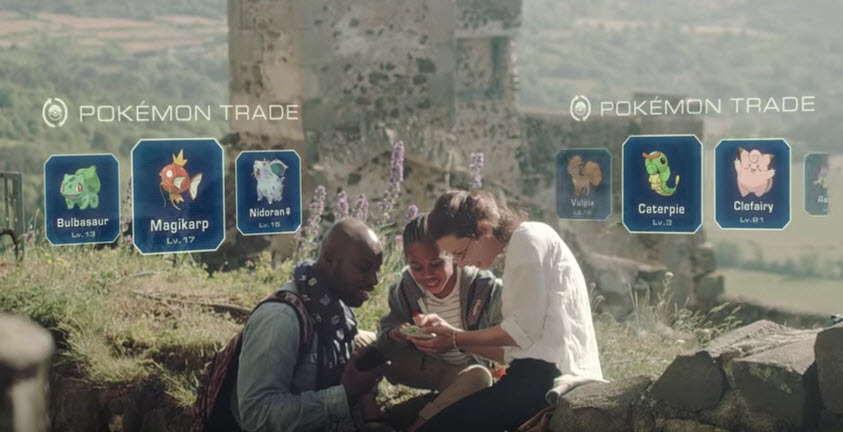
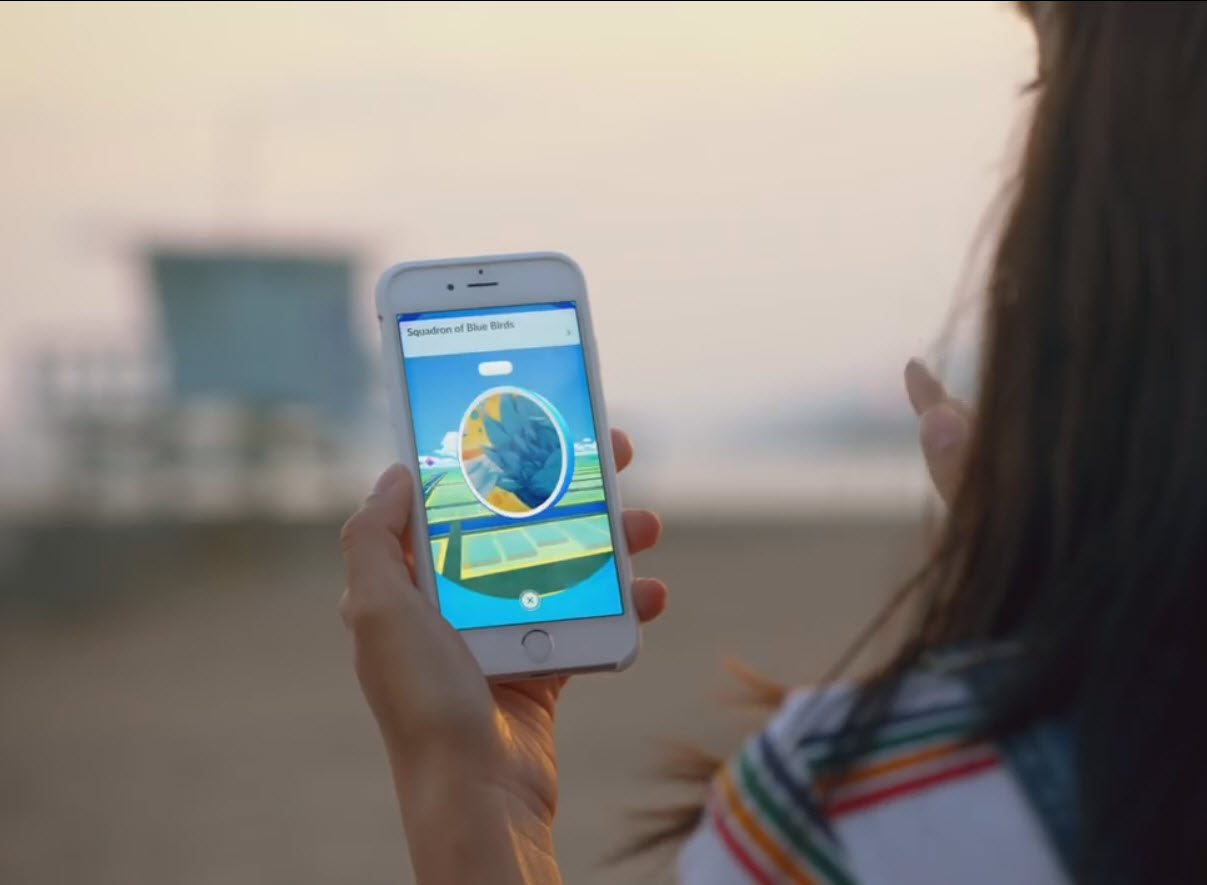
Woman plays Pokemon Go on telephone

“Gets people out of the house instead of sitting around in the house playing video games. Pokemon Go got more people active than Michelle Obama could.” (USA, 23)

“As I see people in the streets with their phones playing it, I imagine streets and cities becoming free playgrounds.” (France, 35)

“Interactivity and GPS component gives the game a unique and innovative character.” (Germany, 29)

“Because it turns ‘life’ into a game. Places, locations get more exciting.” (Germany, 30)

“It brings gaming to a next level – not being inside, a closed room, but being able to play outside; walking the streets, engaging with ‘real life’ other people is truly innovative.” (Germany, 25)

Nostalgia

There is clearly a nostalgic part for those born in the 1980s and early 90s, since Pokemon was a childhood toy for them. So the appeal is realizing one’s childhood dreams and reminiscences about one’s youth.

“For people who have grown up with Pokemon, Pokemon Go is nostalgic and that the fantasy of becoming a Pokemon trainer is no longer fantasy.” (Germany, 28)

“Fun challenges since the 90s.” (USA, 35)

“It’s got far less to do with AR and everything to do with enabling the fantasy of living out a beloved childhood game.” (South Africa, 29)

“Pokemon was a big part of my childhood growing up. I made friends by relating to people through this game that started out as no more than playing cards. As big of a fanatic as I am I honestly can say I wasn’t ‘waiting’ for the game to come out, rather I was ‘wishing’ for it to come out. Never in my wildest dreams could I have seen this game becoming reality.” (Anonymous)

The internet connects the world

The discussions clearly show that the internet connects people anywhere and everywhere and keeps them up to date. Borders no longer play a role.

“Pokemon succeeds culture, race, sex, religion. It’s also social interaction with anyone which I think all humans enjoy.” (Australia, 20)

“Through the internet everyone is connected – beyond national borders. The digitalization of our society is becoming increasingly significant in our everyday life, especially in Germany.” (Germany, 24)

“Through the internet we are all connected with each other. One common goal can connect the world.” (Germany, 25)

In a time of political insecurity and terrorist attacks the importance of connection also is found in the gamers’ search for happiness and fun in the augmented reality.

“We are wanting to have fun, get some exercise and be happy. No more drama. Our country is a bit messed up with politics, and media helping to stir the pot with negative news.” (USA, 46)

“The world also needs more happiness, which this game has brought to many. While the news fills our heads with terrible events to ruminate on, Pokemon Go gets us out of our heads, off the couch, and out socializing and getting exercise. It’s a help for so many things, so that’s why we’ve been waiting for it.“ (Anonymous)

“People are more alike than one would care to think. People who play the game, who do not know one another, approach each other without hesitation or fear of rejection, because they see a similarity between them. A yearning for something simple, kind and free of harm. It transcends racial borders, age gaps or material differences.“ (South Africa, 26)

“To get their minds off of all the anger and hatred going on in society right now.” (India, 28)

A new generation

Merging the real world and the digital world has become reality for Generations X,Y and Z

Pokemon Go on cell phone screen“We are becoming increasingly digital and the borders between reality and augmented reality will become blurry.” (Germany, 28)

“Like to escape everyday life and submerge in a different world.” (Anonymous)

“That technique overtakes the reality. And that we try to flee the reality.” (Germany, 25)

Several participants also said the game is showing how society is becoming more digital and maybe even more open to trying out new things. “The willingness to adapt to new things has increased,” one said.

“There was a cultural change towards micro-transactions. Especially players below 18 years are willing to invest a lot of money for gimmicks. 10 years ago this was still frowned upon.” (Germany, 23)

Fad or not?

Almost all the participants agree that Pokemon Go is the flavor of the moment and its popularity won’t last long as other applications are introduced. “It has been a milestone for this kind of gaming and many others will follow,” one participant said. “The game can probably lose attention quite fast, the technology, on the other side, can highly influence future apps,” another said.

While the game can quickly become repetitive, it might inspire “developers to program games, where people can interact, compete or collaborate in real-life, worldwide, in real-time,” one participant said.

It was suggested that there is still room for improvement. The social component is missing and there is no chat function or things such as friends lists. Adding these may be important.

Safety and addiction also were raised as concerns.

“But the amount of people doing stupid stuff while playing. People so engrossed in the game that they lose track of their surroundings – proving deadly in some occasions. I don’t care for playing Pokemon Go, but find it funny how addicted people are to the game.” (South Africa, 46)

Summary

“The game is combining innovative technique with a game that is provoking nostalgic feelings. Renewing these old memories and to bring them on a modern, digital level seems to be very well accepted. This shows the striving of our society towards innovation and advancement as well as sticking to and reminisce the past.” (Germany, 20)

Conclusion

This quick dive into the minds of global participants in an online community allowed the team to quickly understand the drivers of this phenomenon.

Images were taken from Pokemon Go official videos